
Research
High‑Fidelity Seismic Super‑Resolution Using Prior‑Informed Deep Learning with 3D Awareness
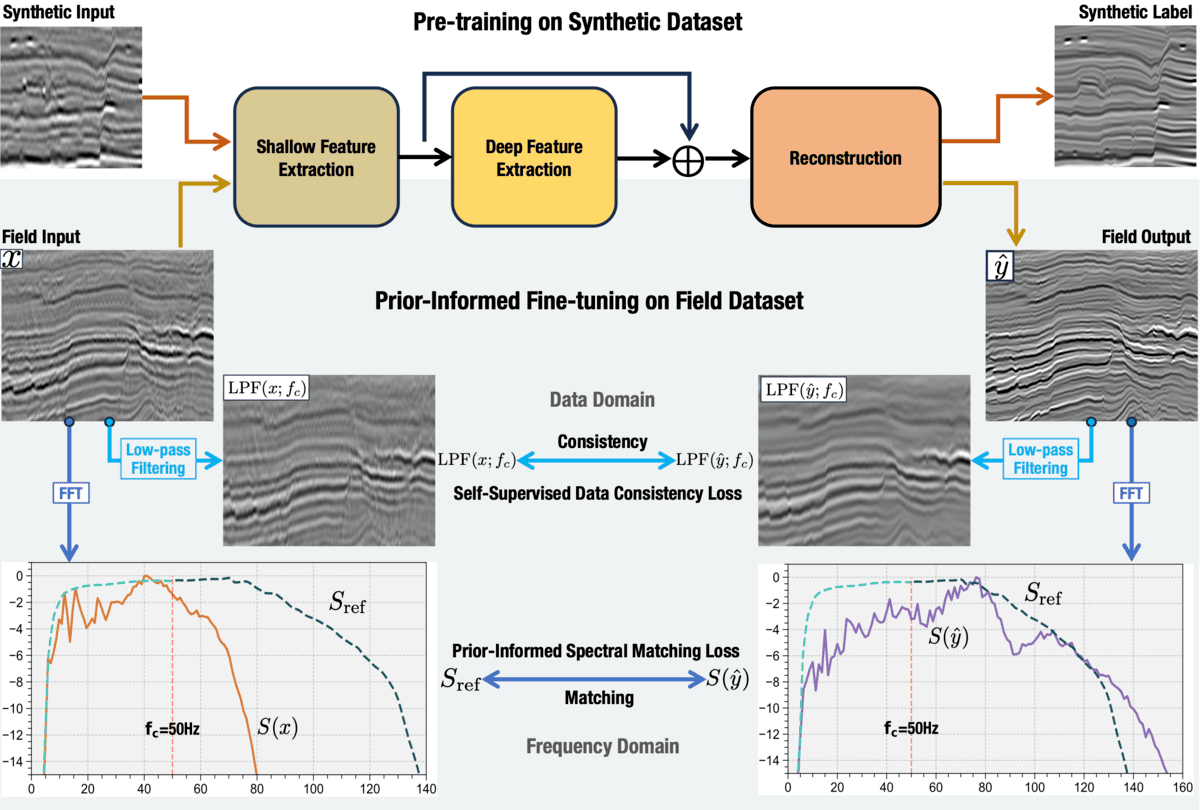
The limitations of seismic vertical resolution pose significant challenges for the identification of thin beds. Improving the vertical resolution of seismic data using deep learning methods often encounters challenges related to unrealistic outputs and limited generalization. To address these challenges, we propose a novel framework that improves the fidelity and generalization of seismic super-resolution. Our approach begins with the generation of realistic synthetic training data that aligns with the structural and amplitude characteristics of field surveys. We then introduce an enhanced 2D network with 3D awareness, which builds on the 2D Swin-Transformer and 3D convolution blocks to effectively capture 3D spatial features while maintaining computational efficiency. This network addresses the limitations of traditional 2D approaches by reducing stitching artifacts and improving spatial consistency. Finally, we develop a prior-informed fine-tuning strategy using field data without the need for labels, which incorporates a self-supervised data consistency loss and a spectral matching loss based on prior knowledge. This strategy ensures that the super-resolution results preserve the original low frequency information while yielding a spectral distribution as expected. Experiments on multiple field datasets demonstrate the robustness and generalization capability of our method, making it a practical solution for seismic resolution enhancement in diverse field datasets.
Memory-Efficient Full-Volume Inference for Large-Scale 3D Dense Prediction without Performance Degradation
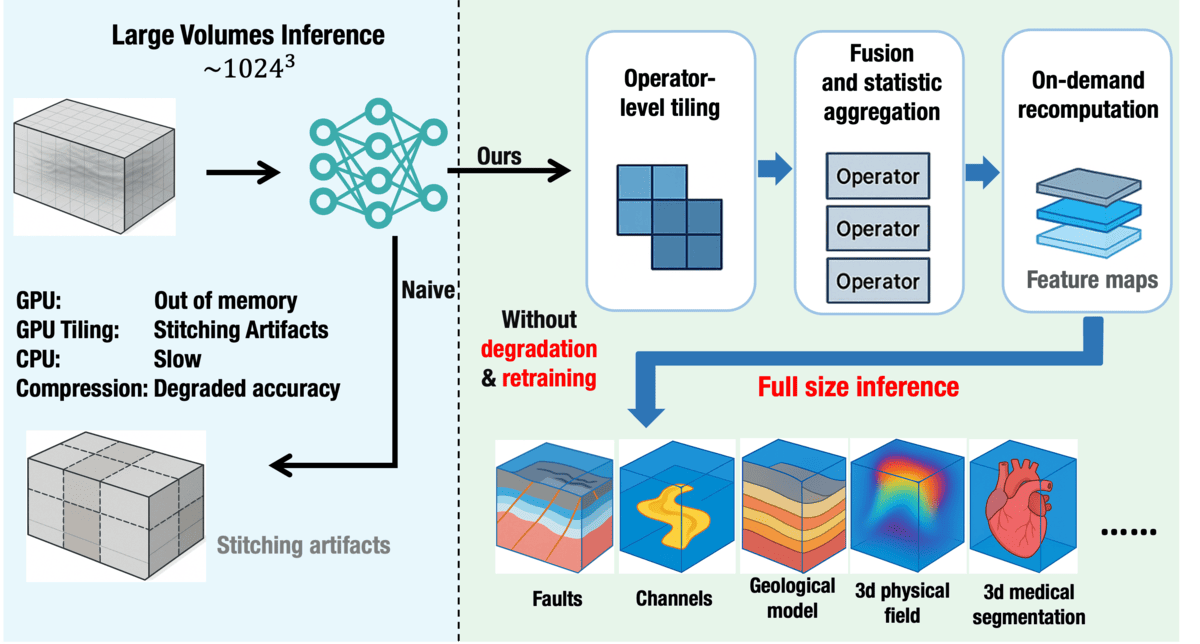
Large-volume 3D dense prediction is essential in industrial applications such as energy exploration and medical image segmentation. However, existing deep learning models struggle to process full-size volumetric inputs at inference due to memory constraints and inefficient operator execution. Conventional solutions—such as tiling or compression—often introduce artifacts, compromise spatial consistency, or require retraining. We present a retraining-free inference optimization framework that enables accurate, efficient, whole-volume prediction without any performance degradation. Our approach integrates operator spatial tiling, operator fusion, normalization statistic aggregation, and on-demand feature recomputation to reduce memory usage and accelerate runtime. Validated across multiple seismic exploration models, our framework supports full size inference on volumes exceeding \(1024^3\) voxels. On FaultSeg3D, for instance, it completes inference on a \(1024^3\) volume in 7.5 seconds using just 27.6 GB of memory—compared to conventional inference, which can handle only \(448^3\) inputs under the same budget, marking a \(13\times\) increase in volume size without loss in performance. Unlike traditional patch-wise inference, our method preserves global structural coherence, making it particularly suited for tasks inherently incompatible with chunked processing, such as implicit geological structure estimation. This work offers a generalizable, engineering-friendly solution for deploying 3D models at scale across industrial domains.
(This paper was unanimously recognized by all three named reviewers: Peer Review File)
CIGVis: an open-source Python tool for real-time interactive visualization of multidimensional geophysical data
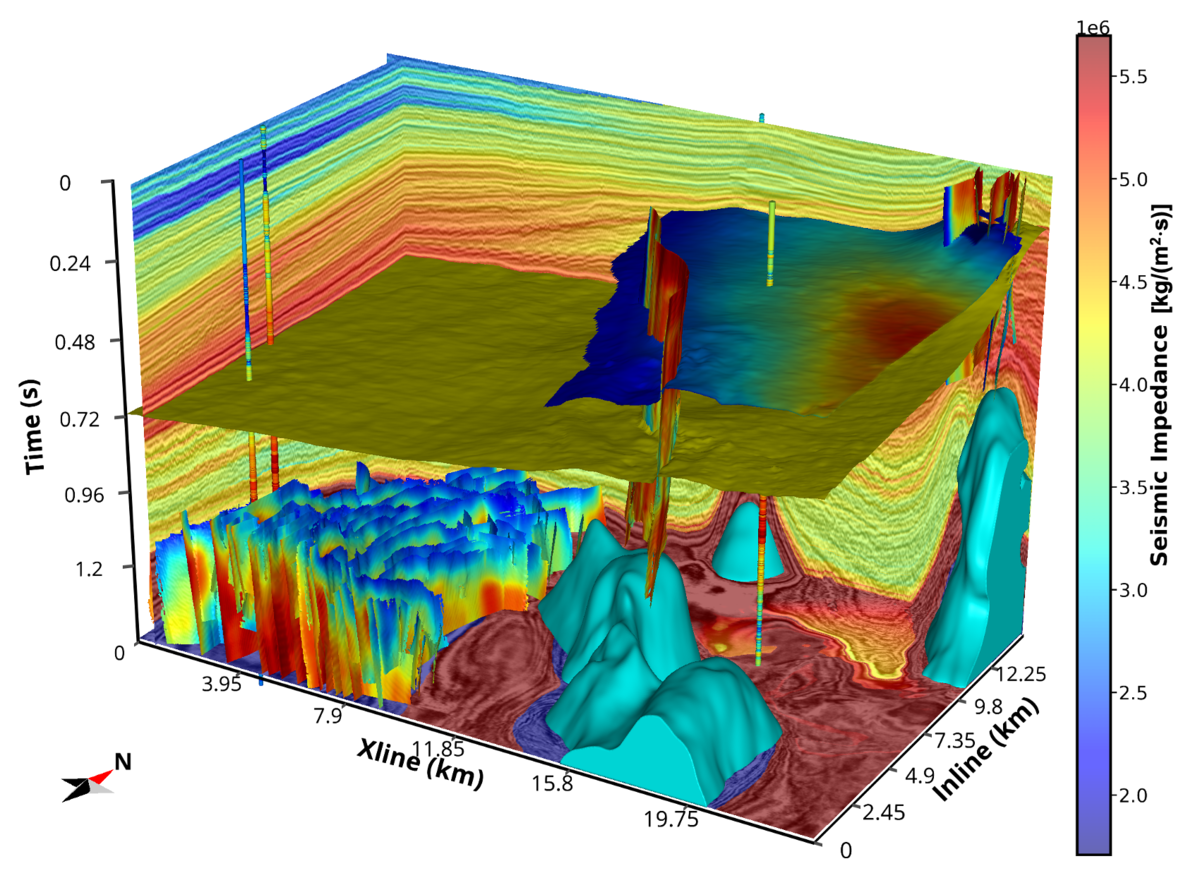

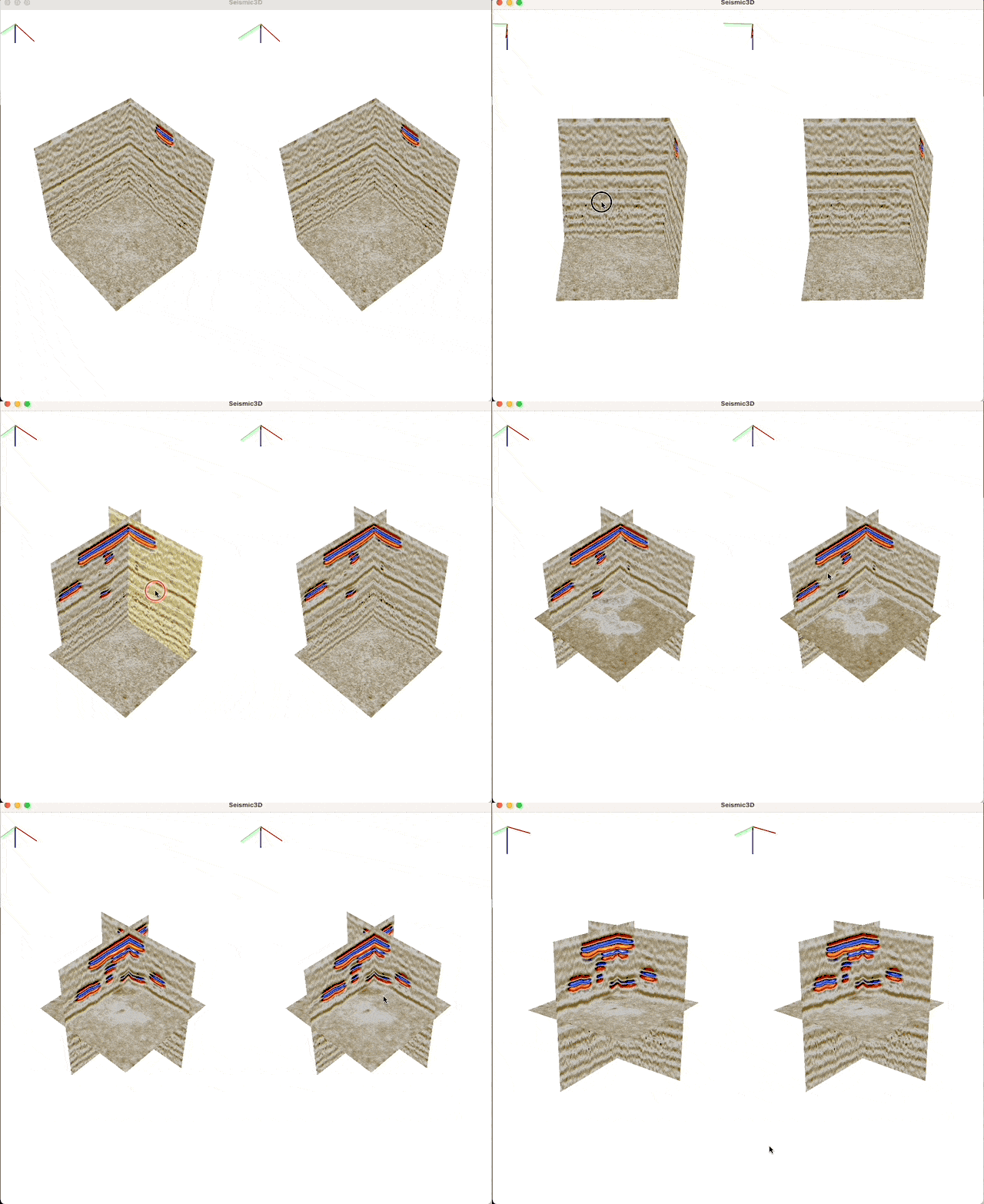
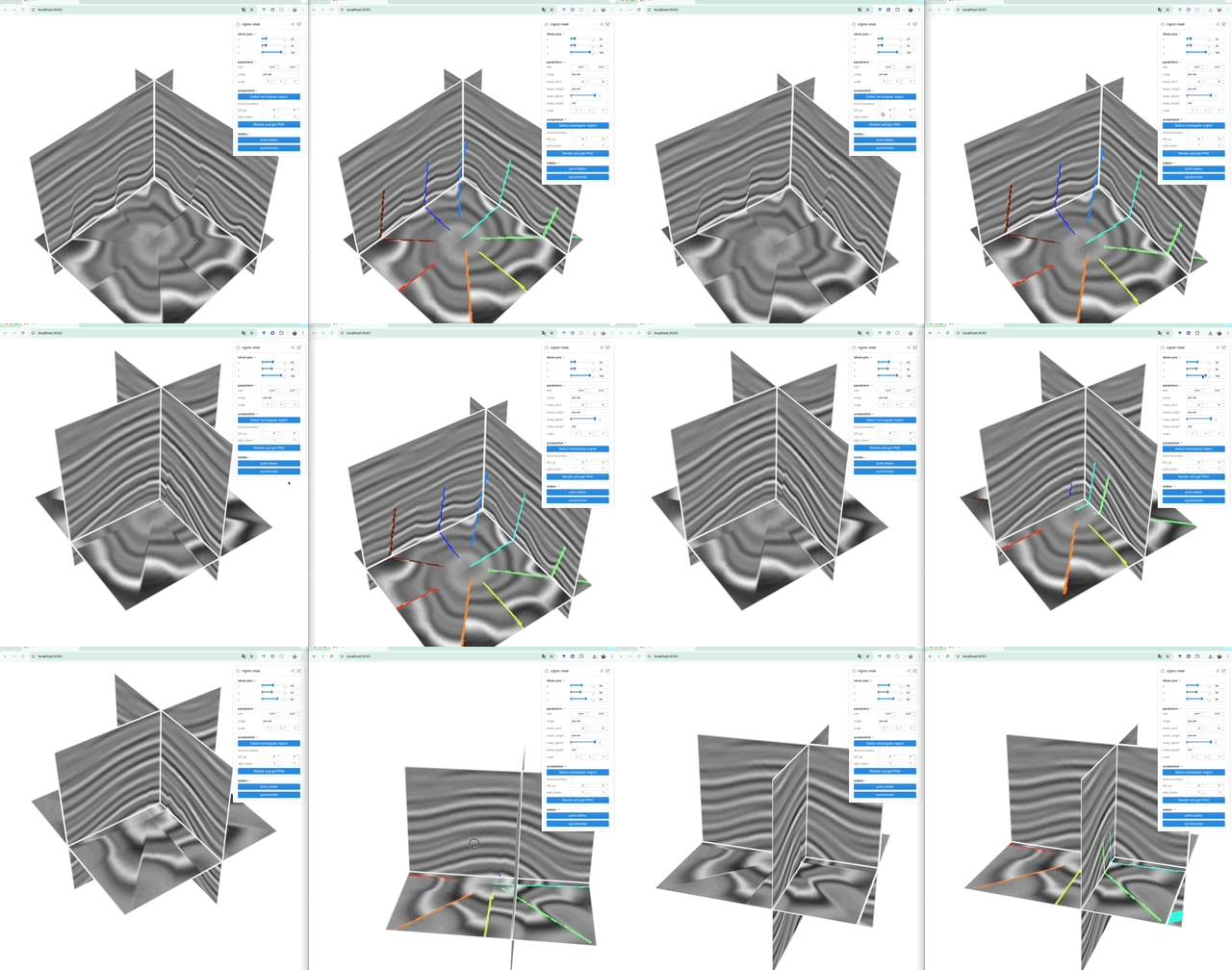
As Python’s role in processing and interpreting geophysical data expands, the need for a Python-based tool tailored for visualizing geophysical data has become increasingly critical. In response, CIGVis was developed - a fully open-source Python tool optimized for researchers and licensed under the MIT. It specializes in real-time, interactive visualiza- tion of multidimensional geophysical data, including 3D seismic, faults, horizons, geological bodies, and well logs. CIGVis enables users to interact with data through operations such as rotation, movement, zooming, and dragging slices. It also supports a multi-canvas functionality, allowing simultaneous visualization across multiple sub-canvases with a unified camera perspective. Its ease of use allows for effective visualization with just a few lines of code across all major operating systems, and extends to both desktop and Jupyter environments, facilitating code execution in various settings. The core functionalities of CIGVis are exemplified using straightforward datasets, such as the F3 dataset.